Pecked, Ground and Polished Tools
During the Archaic Period, the inhabitants of the Ottawa Valley used axes, adzes and gouges for the first time. These tools reveal the importance of woodworking in daily life. Gouges were probably used to hollow out tree trunks to make dugout canoes, containers or platters. Axes and adzes could have been used to cut and split wood.
The tools shown here had to be made of stone that could withstand significant impact. The stone was initially shaped by chipping to remove small flakes. Harder stones were used to peck the roughed-out form, creating small pits on the surface of the tool. The final shape was obtained by grinding with sand and water or abrasive stones.
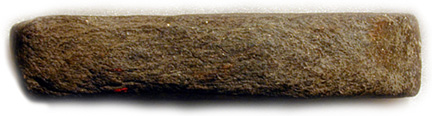 | Axe
Ottawa
3,000-5,000 years old
Length: 21 cm
Gift of the Ottawa Literary and Scientific Society, 1884
CMC VIIIF-8901 | 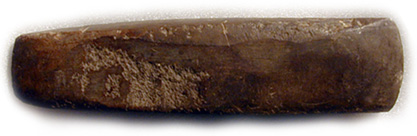 | Double-bitted axe
Cambridge Township, Russell County, Ontario
3,000-5,000 years old
Length: 23.5 cm
Gift of Antoine Queiville, 1912
CMC VIIIF-9013 |  | Three-quarter grooved axe
Ottawa
3,000-5,000 years old
Length: 11 cm
Gift of the Ottawa Literary and Scientific Society, 1884
CMC VIIIF-8988 |
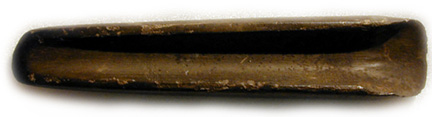 | Fully grooved gouge
Fitzroy Township, Carleton County, Ontario
3,000-5,000 years old
Length: 23 cm
Gift of Heman Kedey, Fitzroy Harbour, 1919
CMC VIIIF-15664 | 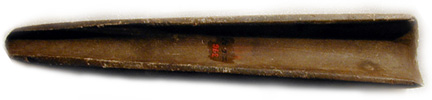 | Fully grooved gouge
Mouth of the Picanoc River, near Gracefield, Quebec
3,000-5,000 years old
Length: 35 cm
Gift of B. Fisher, Ottawa, 1882
CMC VIIIE-27 | 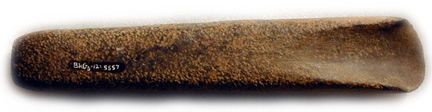 | Gouge
Morrison's Island, Quebec
(near Pembroke, Ontario)
5000 years old
Length: 27.5 cm
Gift of Clyde Kennedy, 1994
CMC BkGg-12-5557 |
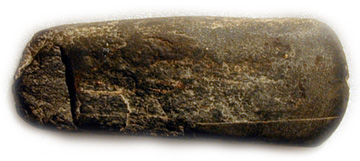 | Axe
Fitzroy Township, Carleton County, Ontario
400-5,000 years old
Length: 17.5 cm
Gift of Heman Kedey, Fitzroy Harbour, 1919
CMC VIIIF-15666 | | | |
|