ALGONKIN AND HURON OCCUPATION OF
THE OTTAWA VALLEY
(originally published in 1909, The Ottawa
Naturalist,
Vol. XXIII, No. 4: 61-68 & Vol. XXIII, No. 5:92-104)
By T. W. Edwin Sowter
To the student of Indian archaeology, the great highway of the Ottawa
will always be a subject of absorbing interest. As yet, it is
almost
a virgin field of inquiry, as f ar as any systematic effort has been
made
to exploit it. As yet, there are vast stores of information,
along
this old waterway, which await the magic touch of scientific
investigation,
to be turned into romance chapters of Canadian history. Sooner,
or
later, we must appreciate these potential opportunities for the
collection
of data that may solve many important ethnic problems, which have been
transmitted to us from the dim twilight of prehistoric times and are,
as
yet, only presented to us in the will-o'-the-wispish light of
tradition.
The Ottawa River may yet furnish us with clues to the elucidation of
much
that is problematical in regard to areas of occupation, migrations and
dispersions of some of our great native races, who were leading actors
in many of the tragic wilderness dramas, that were played out in Canada
before and after European contact.
The early Jesuit missionaries have left us, in their Relations
a priceless
record of Algonkin and Huron sociology, as well as an invaluable basis
for the study of such of the Indian tribes of Canada as came within the
sphere of their activities. As those gentle and lovable pioneers
of the Cross were among the first Europeans to come in contact with
these
red children of the forest, they enjoyed exceptional opportunities for
observing their habits of thought and action, ere their primitive
folk-lore
and traditions had been modified by the cradle stories of the
pale-faces.
We are told by Parkman, one of the most trustworthy historians
of modern
times, that "By far the most close and accurate observers of Indian
superstition
were the French and Italian Jesuits of the first half of the
seventeenth
century. Their
page 61
page 62
opportunities were unrivalled; and they used them in a spirit
of faithful
inquiry, accumulating facts, and leaving theory to their
successors."
It is for this reason that the Jesuit Relations should be regarded as
the
groundwork of Indian archaeology, as far as Canada is concerned.
They were written by men of absolute integrity, who have given us as
much
of the life history of the individual, the clan and the tribe, as came
under their observation; or as they were able to obtain from the most
trustworthy
sources. They describe the Indian, as they found him, embowered
in
the seclusion of his native forests; surrounded by innumerable okies or
manitous, both benevolent and maligant, to whom he appealed for aid in
the hour of his need, or propitiated with sacrifices; venerating, with
a sentiment akin to worship, such animal ancestors as happened to be
the
prototypes of his various clans; adhering to mythologies that agreed
well
in essentials though somewhat loosely defined in matters of detail;
believing,
in his Nature-worship, in the soul or spirit of the lake, the river and
the cataract; but without any vestige of belief in that personification
of beneficence called "The Great Spirit" who was presented to him
afterwards
by the missionaries, as the archetype of mankind, and recommended to
him
as the Supreme Being whom he should worship.
That the Jesuit record has been dictated by a spirit of
truthfulness,
is apparent from its impartial treatment of Indian tradition and
worship;
for, while some writers have endeavored to interpret Indian mythology
in
such a manner as to make it conforrn to the bias of preconceived
theories,
these worthy apostles of the Cross have given us the simple truth
without
embellishments. Examples of this kind may be found in Ragueneau's
Relation, of 1648, in which he refers to the Hurons "as having received
from their ancestors no knowledge of God; and in the denial of Allouez,
in his Relation of 1667, that any such knowledge existed among the
tribes
of Lake Superior. It is not probable that these men would have
failed
to recognize any such belief had the case been otherwise. Thus,
these
subtle reasoners, and past-masters in theological disquisition, were
unable
to discover, in such manitous as Manabozho, or the Great White Hare of
the Algonkins, or, in Rawen Niyoh, the great oki of the Huron-Iroquois,
beings analogous to the white man's God.
Now, the writer is convinced that this field of archaeological
inquiry
should be entered, with the assistance of the "open se-same" of the
historical
record; and that, by following up the clues, transmitted to us by the
Jesuits
and other contemporary writers, we should devote our attention to such
portions of this field as are most likely to yield the best results,
under
careful and methodical cultivation.
page 62
page 63
The great stream, which forms the main boundary between the
provinces
of Ontario and Quebec, was called in early times the River of the
Ottawas;
but, it might have been named, also,theRiverof the Hurons. Owing
to its geographical position, it offered the advantages of a direct and
convenient highway between the French settlements on the St. Lawrence
and
the Indian tribes of the Great Lakes. This river, especially in
the
seventeenth century, was traversed bv Algonkins and Hurons, Frenchmen
and
priests, following, either along its shores or at its distant
terminals,
their varied pursuits of explorers, fur-traders, scalp-hunters or
ministers
of the gospel. Sometimes, huge fleets of canoes, bearing red
embassies
from the west, or white punitive expeditions from the east,
consignments
of furs to the St. Lawrence trading posts, or native supplies for the
winter
hunt, black robed Jesuits with donnés or artisans for their
western
missions, passed up or down this great highway; while, at other times,
fugitive parties, both white and red, crept along the shadow of its
shores
to avoid some scalping-party of the ubiquitous and dreaded Iroquois.
We are thus indebted to historical testimony for much of our
knowledge
of what took place on the Ottawa, since the beginning of the French
régime.
We should now endeavour to amplify this knowledge, by the accumulation
of such data as may be derived from the domain of archaeology.
The
prospects in this direction, though somewhat dubious at first sight,
are
much improved on closer acquaintance.
It is no great tax upon our ingenuity to discover traces of
the presence
of French and Indians on the Ottawa, in bygone times. The Indian dictum
that,"water leaves no trail," applies, only to the deeper parts of the
stream; for the writer, has in his collection, stone tomahawks of
native
manufacture, together with trade bullets, which were taken from the
shallow
shore-water of this river. It is, however, in the ancient camping
grounds, which dot the shores of the Ottawa at frequent intervals, that
we should search for traces of early human occupation. As the
recovery
of the loose leaves, which have been lost out of some old story book,
is
necessary to complete the tale; so is the interpretation of the sign
language
of these camp-sites, a requisite for the recovery of many lost or
unwritten
pages of our historical manuscript.
Great care should be taken in the examination of these
places.
The ground should be all gone over on the hands and knees, as, with his
nose to the ground, so to speak, one is not liable to overlook anything
of importance. As he is about to turn up a chapter on the social
and domestic life of a native community, he should observe the
topographical
features of the
page 63
page 64
site and the position it occupies relative to the main river,
whether
situated on its margin or at any considerable distance away from its
shores;
and also, its proximity to smaller streams that might have been
navigated
by canoes before the deforestation of the district . He should first of
all examine the surface before disturbing it; after which he may search
out, the secrets concealed in the ashes of dead camp fires, by passing
the ashes through a sieve, so as to retain such works of art as might,
otherwise, pass unnoticed. Every work of art, or portion thereof,
should be studied with great care, even to apparently insignificant
fragments.
The composition of pottery should be noted and efforts made to discover
if its ingredients are obtainable in the vicinity. All forms of
arrow-heads
should be noted, as well as the color and character of the flint, or
other
material, from which they have been fabricated, and, if possible, the
source
from which this material has been derived should be ascertained.
Arrow-heads, that appear to be of foreign make, as differing from the
prevailing.
forms, should be noted for future reference and comparison.
Search
should also be made amidst the usual litter of the flint workshops, in
the locality, for evidences of domestic manufacture, such as pieces of
raw material, flakings of heads that have been spoilt in the making and
discarded by the ancient workmen. This flint refuse is found in
greatest
abundance about the bases of large boulders, which appear to have been
utilized by the prehistoric artificers, as convenient work-benches in
their
primitive industries. Articles of European workmanship, which are
too apt to be considered as of little consequence, should be searched
for
with the greatest diligence, making due allowance of course, for the
difference
in relative values between such finds as the rude pistol flint of the
ancient
hunter, and the metal cap or stopper from the pocket pistol of the well
equipped modern fisherman. A sharp lookout should also be kept
for
implements of slate, especially such as are fabricated from the
Huronian
variety; and, as a last but most important recommendation, the location
of the camp site should be kept a secret from relic hunters, until its
examination has been completed.
C.C. James, in his Downfall of the Huron Nation, says that
"The history
and downfall of the Hurons may be studied in three sources. 1st.
The traditions of the Indians themselves. 2nd. The letters of the
Jesuit Fathers, the written records commonly called The Jesuit
Relations.
3rd. Modern archaeological research and ethnological
investigation.
These three contributers to a common story are widely different in
method,
and when they verify one another we are bound to accept the conclusions
as facts of history." It may be said also that the
page 64
page 65
same sources of information are available in studying the
question of
Algonkin and Huron occupation of the Ottawa Valley. We have
already
considered the value of the Jesuit writings, let us now examine some of
the traditions of the Indians themselves.
Life on the old Ottawa, during the greater part of the
seventeenth century,
was always strenuous and frequently dangerous. On this rugged old
trade route, during the french régime, the fur-traders from the
interior, both white and red, experienced many vicissitudes while
conveying
the products of the chase to the trading posts on the St.
Lawrence.
Shadowy traditions of those days of racial attrition, have been
transmitted
from father to son, from the old coureurs de bois and their Indian
confreres,
to their half-breed descendants of the present day. These
traditions
account for the human bones washed out some years ago at the foot of
the
old Indian portage at the Chats, and those that are scattered in great
profusion at Big Sand Point, lower down the river; also, for quite a
number
of brass kettles found at one time near the mouth of Constance Creek,
for
the Indian burials on Aylmer Island, as well as for the presence of
arrow-heads,
stone celts, flint knives and other native implements in the gravel
beds
at the foot of the Chaudière, and,without pausing to consider
whether
these relics of a departed people are not the ordinary litter of Indian
camp-sites, or the disinterred bones from Indian burial places,
tradition,
as usual, takes charge of them as the ominous tokens of a period of
violence.
At Big Sand Point there is a sand mound or hillock, fringed
with scrubby
trees, which has the uncanny reputation of having been once the home of
a family of Wendigoes. These Wendigoes, as is usual with this
species
of manitou, were a source of constant annoyance to the native dwellers
on the shores of Lake Deschênes but more particularly to an
Algonkin
camp on Sand Bay, quite close to the headquarters of these malignant
spirits.The
old man, who possessed the gigantic proportions of his class, was
frequently
seen wading about in the waters of the bay, when on foraging
expeditions
after Indian children of whose flesh, it is said, he and his family
were
particularly fond. The family consisted of the father, the mother
and one son. The bravest Indian warriors had, on several
occasions,
ambushed and shot at the old man and woman without injuring either of
them,
but, by means of sorcery, they succeeded in kidnapping the boy, when
his
parents were away from home. Holding the young hopeful as a hostage,
they
managed to dictate terms to his father and mother and finally got rid
of
the whole family.
The writer heard this story one night while camping at the
Chats and,
though far from believing than any sane Indian of the old school would
have laid violent hands on even a young
page 65
page 66
Wendigo, he is quite satisfied that had one of those legendery
monsters
of the American wilderness loomed suddenly out of the dark shadows of
the
forest and approached the camp fire, the poor half-breed, who was
"spinning
the yarn" would have immediately taken to his canoe and left the
Wendigo
in undisputed possession of the island.
As it is around this same sand mound, the old Wendigo
homestead at Big
Sand Point, that the scattered bones, already alluded to, are found, it
seems strange that the story tellers do not represent them as the
remains
of the cannibal feasts of its former occupants. These evidences
of
mortality, however, are accounted for in another tradition, that tells
of a war-party of Iroquois who, having taken possession of and
entrenched
or barricaded the old Wendigo mound, defended themselves to the death
against
a force of French and Indians, who surprised them in a night-attack and
butchered them to a man.
This story seems to carry us back to that period of conflict
which was
inaugurated by the onslaught of the Iroquois upon the Huron towns,
which
was continued with unparalled ferocity and terminated only by the
merciless
destruction of a once powerful nation and the final dispersion of its
fugitive
remnants, together with such bands of Algonkins as happened to come
within
the scope of that campaign of extermination. It is supposed that
our tradition has reference to one of the many scenes of bloodshed
which
reddened the frontiers of Canada, while the Confederates were thus
making
elbow-room for themselves on this continent, and were putting the
finishing
touches on the tribes to the north of the Great Lakes and the
St.Lawrence.
At this time all the carrying-places, on our great highway, were
dangerous,
for war-parties of the fierce invaders held the savage passes of the
Ottawa,
hovering like malignant okies amidst the spray of wild cataracts and
foaming
torrents, where they levied toll with the tomahawk and harvested with
the
scalping-knife the fatal souvenirs of conquest.
Sand Bay, at the outlet of Constance Creek, in the township of
Torbolton,
Carleton Co., Ont., is a deep indentation of the southern shore line of
the Ottawa, extending inland about a mile. The entrance, or river front
of the bay, is terminated on the west by Big Sand Point, and on the
east
by Pointe à la Bataille, the two points being about a mile
apart.
The latter is now shown on the maps as Lapotties Point, a name of
recent
origin and doubtless conferred upon it by some ox-witted yokel, it
should
bear the name of its latest occupant, which probably commemorated some
tragic incident of a bygone age. The French Canadian
river-men,
page 66
page 67
however, with much better taste, still retain the name by
which it was
known to the old voyageurs.
A great many years ago, so the story goes, a party of French
fur-traders,
together with a number of friendly Indians, possibly Algonkin and Huron
allies, went into camp one evening at Pointe à la
Bataille.
Fires were lighted, kettles were slung and all preparations made to
pass
the night in peace and quietness. Soon, however, the lights from
other camp fires began to glimmer through the foliage on the opposite
shore
of the bay, and a reconnaisance presently revealed a large war-party of
Iroquois in a barricaded encampment on the Wendigo Mound at Big Sand
Point.
Well skilled as they were in all the artifices of forest warfare, the
French
and their Indian companions were satisfied that something would happen
before morning. It was inevitable that the coming night would be
crowded with such stirring incidents as would leave nothing to be
desired,
in the way of excitement. There lay the Iroquois camp, with its fierce
denizens crouched like wolves in their lair, though buried in the heart
of the enemy's country, yet self-reliant in the pride of warlike
achievements,
whose military strategy had rendered them invulnerable as the gloom of
the oncoming thundercloud, and as inexorable as the fate of the forest
monarch that is blasted by a stroke of its lightning.
Now the golden rule on the Indian frontier in those strenuous
times,
was to deal with your neighbor as you might be pretty sure he would
deal
with you, if he got the chance. Of course it was customary, among
the Indians to heap coals of fire on the head of an enemy, but as it
was
the usual practice, before putting on the coals, to bind the enemy to
some
unmovable object, such as a tree or a stout picket, so that he was
unable
to shake them off, the custom was not productive of much brotherly
love.
Moreover, when the success of peace overtures could be assured only to
the party that could bring the greater number of muskets into the
negotiations,
it will be readily understood why the French, who were in the minority,
did not enter into diplomatic relations with the enemy. On the
contrary,
it was resolved to fight as soon as the opposing camp was in repose,
and
attempt a decisive blow from a quarter whence it would be least
expected,
thus forestalling an attack upon themselves, which might come at
anytime
before the dawn. The French and their allies knew very well that
if their plans miscarried and the attack failed, the penalty would be
death
to most of their party, and that, in the event of capture, they would
receive
as fiery and painful an introduction to the world of shadows as the
leisure
or limited means of their captors might warrant.
Towards midnight, the attacking party left Pointe à la
Bataille
and
page 67
page 68
proceeded stealthily southward, in their canoes along the
eastern rim
of Sand Bay, crossed the outlet of Constance Creek and landing on the
western
shore of the bay advanced towards Big Sand Point through the pine
forest
that clothed, as it does to-day, the intervening sand hills. This
long detour, of about two miles, was no doubt a necessity, as, on still
nights, the most trifling sounds, especially such as might have been
produced
by paddles accidently touching the sides of canoes, are echoed to
considerable
distances in this locality.
The advance of the expedition was the development of Indian
strategy,
for, by getting behind the enemy, it enabled the French and their
allies
to rush his barricades and strike him in the back, while his sentinels
and outliers were guarding against any danger that might approach from
the river front.
The attack was entirely successful, for it descended upon and
enveloped
the sleeping camp like a hideous nightmare. Many of the Iroquois
died in their sleep, while the rest of the party perished to a man, in
the wild confusion of a midnight massacre.
Such is the popular tradition of the great fight at the
Wendigo Mound
at Big Sand Point, and the bones that are found in the drifting sands
at
that place, are said to be the remains of friend and foe who fell in
that
isolated and unrecorded struggle.
Let us now descend the river, as far as the Chaudière,
and we
find ourselves once again in the moccasin prints of the Iroquois; for
those
tirelss scalp hunters were quite at home on the Ottawa, as well as on
its
northern tributaries. War expeditions of the Confederates
frequently
combined business with recreation. They would leave their homes
on
the Mohawk or adjacent lakes and strike the trail to Canada by way of
the
Rideau Valley, hunt along that route until the spring thaws set in, and
manage to reach the Ottawa in time for the opening of navigation.
Then they loitered about the passes of the Chaudière and waited,
like Wilkins Macawber, for something to turn up.
While waiting thus for their prey to break cover, from up or
down the
river, they devoted their spare time to various occupations. To
the
oki, whose thunderous voice was heard in the roar of the falls, they
made
sacrifices of tobacco; while the Mohawks and Onondagas each gave a name
to that cauldron of seething water which is known to us as The Big
Kettle.
The Mohawks called it Tsitkanajoh, or the Floating Kettle, while the
Onondagas
named it Katsidagweh niyoh or Chief Council Fire. It is possible that
our
Big Kettle may be a modified or corrupted translation of the Mohawk
term.
(To be continued ).
page 68
page 92
(Continued from page 68)
Iroquois tradition assigns to Squaw Bay, called also Cache
Bay, at Tetreauville,
the reputation of having been one of the favorite lurking places of
these
war-parties. It must have been in those days, an ideal spot for
an
ambush or concealed camp, as it occupied, for the purposes of river
piracy,
as unique a position on the old trade route, as does one of our present
day toll-gates, for controlling the traffic on a turnpike road.
There
is no doubt of the place having been used as an Indian camping ground,
at least in prehistoric times, as the shores of the bay are littered
in,
all directions with fragments and flakes of worked flint. This is
an instance in which tradition is corroborated, to some extent, by
archaeology.
It is also said that Brigham's Creek, called also Brewery
Creek, a narrow
channel of the Ottawa, was the old Indian portage route for overcoming
the rapids of the Chaudière. It may be seen by glancing at
a map of the city of Hull, that parties of Algonkins or Hurons, as the
case may have been, upon emerging on the main river at the head of this
portage, were liable at any time to receive a warm welcome from some
surprise-party
of Iroquois visitors at the Squaw Bay camping ground. If
descending
the rapids of the Little Chaudière, they faced a far worse
predicament,
as, unable to escape or defend themselves in the swift current, they
would
have been caught, like passing flies that are blown into a spider's
web.
It is said that Indian cunning was at length successful in
evolving
a plan to outwit the military strategy of the Iroquois. As the old
portage
route had become dangerous it was resolved to have an alternative one.
In ascending the Ottawa, this new portage started from the western
shore
of Brigham's Creek at a point now occupied by the International Cement
Works. It continued thence in a westerly direction, skirting the
foot of the mountain and passed down Breckenridge's Creek to the outlet
of that stream into Lake Deschênes. It was rather a long
portage
of about a dozen miles, but the Algonkin and Huron had learned in the
school
of bitter experience, that, in their case, the longest way round was
the
shortest way home. An aged squaw, who many years ago, spoke of a
similar forest trail that extended, in the early days, from a point on
the Gatineau
page 92
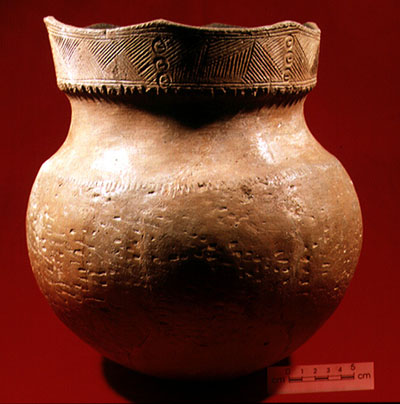
This figure represents a clay vessel, which was found by Mr.
James Lusk,
on his farm, Lot 20, Range XI, Township of Eardley, Wright Co.,
Que.
It was purchased from Mr. Lusk in the year 1903, and is now in the
Archaeological
Section of the Geological Museum at Ottawa, where it is indexed as No.
3282A. The vessel is 11 inches in height and 33 inches in
circumference.
(recent photo by Jean-Luc Pilon, Canadian Museum of
Civilization;
the original illustration is on an un-numbered page between pages 92
and 93)
page 93
near the site of Chelsea, thence by way of Kingsmere to a
point on Lake
Deschênes, now occupied by the town of Aylmer.
Reference has already been made to Indian camping grounds,
which dot
the shores of the Ottawa at frequent intervals. Let us see what
can
be made out of them, by a close examination of the relics they have
yielded.
The writer is convinced that these camp sites are of Algonkin origin,
and
that they bear evidences of casual contact, if not of more prolonged
social
intercourse with the Hurons. That is to say, that it looks as if
the Hurons had been friendly visitors, who had spent much of their time
in these Algonkin camps. These camp sites seem to have been
selected
with a view to observation, defence or escape in cases of sudden
attack.
The Hurons built their villages at some distance from the water
highways,
so as to escape observation by inquisitive tourists, who might wish to
attack them. They also selected their village sites where the
land,
within a convenient distance, was suitable for agriculture. The
highways
of communication used by these village communities, were the
innumerable
forest trails, which traversed the Huron country in all
directions.
On the other hand, the Algonkins of the Ottawa have left traces of
their
camps along the edges of the river, on points of land which afford a
good
view up or down stream. They have been called canoe Indians and
were
at home on the water. As they were much more expert in the
management
of their birchen vessels than the Iroquoian races, they were in a
position,
on the shores of the river, to escape by water from a too powerful
enemy
approaching by land, or they could retire to the forest if an
overwhelming
fleet appeared in the offing.
These camp sites are strewn with fragments of blackish flint,
evidently
procured from the Trenton limestone at the Chaudière, where it
is
found in great abundance, especially along Brigham's Creek, the old
Indian
portage route. Arrow-heads, fabricated from these fragments, are
also found on these Algonkin camp sites. But there is also found
an arrow-head of a different pattern, that is made from flint that has
a lighter color and a broader and cleaner conchoidal fracture than the
Algonkin forms. These arrow-heads bear a striking resemblance, in
every respect, to those from the Huron country in western Ontario and
there
are no flakings of this latter flint to show that they were fabricated
in these Algonkin workshops. This seems to be negative evidence
that
they were not made on the Ottawa, but may have been brought there by
Huron
visitors. It is not, of course, conclusive evidence of Huron
occupation,
but rather of Huron contact, more or less prolonged. A long knife of
Huronian
page 93
page 94
slate, discovered on the Ottawa, by George Burland, with a
broken gorget
and a crescent shaped woman's knife, each of Huronian slate, found on
the
Bonnechere by Edward Moore, of Douglas, Ont., seem to be additional
evidence
of the presence of Hurons in the Ottawa Valley.
There are two other camp sites, however, that differ
essentially from
the foregoing and are without doubt distinctly Huron. The former
of these was discovered by R. H. Haycock, of Ottawa, and the latter by
Dr. H. M. Ami, of the Geological Survey.
In the fall of 1859 and the spring of 1860, the late Edward
Haycock
built a residence in the city of Hull, on the point now occupied by
Gilmour's
Mill. While making excavations for the foundation of a summer
house,
the workmen laid bare several ash-beds, at a depth of from two to three
feet below the surface. Among other things, these beds contained
fragments of Indian pottery in great abundance1. Mr.
R. H. Haycock examined them closely and reports them as having been of
a dark brown color, decorated with incised lines, notches and
indentations.
According to Mr. Haycock's description, this pottery, both in
composition
and decoration, was similar to that unearthed from old ash-beds in the
Huron country, in Ontario.
One may observe, on approaching Hull by the Alexandra bridge,
an extensive
cut bank of sand and gravel, between the E. B. Eddy Co.'s sulphide Mill
and the end of the bridge, and between Laurier Ave., and the
river.
This is the place from which the late Edward Haycock procured sand for
building purposes on the Eastern and Western Blocks of the Departmental
buildings, at Ottawa. During the excavation of this bank, a great
many Indian relics were discovered, such as womens' knives,
arrow-heads,
tomahawks and pottery, but no description of this pottery is,
obtainable.
Here, according to white and red tradition, many bloody encounters took
place between parties ascending or descending the river.
In the archaeological department of the Geological Museum at
Ottawa,
there is a large array of pottery fragments collected by Dr. H. M. Ami,
some years ago, from an old ash-bed at Casselman, Ont. In the
same
cases, are specimens of Huron pottery from village sites in western
Ontario,
and, in comparing the two collections one is quite satisfied that both
are products
1 "In some places rude pottery is
found at a considerable
depth, from different causes. In fire-places this may come from
the
practice of placing the fire in excavations in the ground", Earthenware
of the New York Aborigines. William M. Beauchamp, Bulletin, New
York
State Museum, Vol. 5. No. 22, p. 80.
page 94
page 95
of the same school of ceramic art. The ash-bed was large
and deep
and Dr. Ami is of the opinion that it had been used as a fire-place for
a considerable length of time. There is no doubt that Dr. Ami's
discovery
is of the highest importance in establishing proofs of Huron occupation
of the Ottawa valley.
There are, also, in the Museum, two perfect specimens of
Indian pottery
from lot 20, range 11, Eardley township, Wright Co., Que. They
were
procured from James Lusk, who discovered them on his farm, where they
had
been washed out of the banks of a small creek during a freshet.
They
are superb examples of aboriginal art, and it is difficult to
understand
how they could have been brought to such symmetrical proportions
without
the use of a lathe. Compared with similar vessels figured in the
Ontario Archaeological Reports, it seems impossible to doubt that they
are of Huron origin. These vessels are similar in pattern and have been
fabricated from the same clayey composition, with the same band,
decorated
with characteristic incised lines, about the top, and a wavelike edge
on
the summit of the rim, as are found in some of the Huron forms.
As
to whether the spot where this pottery was found is an ancient village
site, will be an interesting subject for future investigation.
Let us now consider another phase of the question of Huron
occupation,
that seems to be more conclusive even than the discovery of ash-beds or
pottery, the evidences of ossuarial burial. The graves of a
nation
are indexes of its intellectual development, from the rude cairn of the
wandering savage to the Taj Mahal of the imperial ruler. Could we
have mingled in the activities of palaeocosmic man, and witnessed the
riteof
sepulture by which the Old Man of Cro-Magnon was laid to rest in his
cave-sepulchre
on the Vezére, in the Dordogne Valley, then, the last rites
about
the grave of that post-glacial patriarch might have yielded us a store
of knowledge that would have been invaluable to us in studying the
savage
culture of ancient Europe, such as the rude efforts of primitive man to
interpret natural phenomena or to recognize in the variant
manifestations
of natural forces the evidences of divine anger or approbation.
So,
also, if we could have witnessed the burial rites of the Huron nation,
in what was called the Feast of the Dead, they would have proved most
instructive.
They might have cleared up much that is obscure in regard to the
ultimate
destiny and relationship of the two souls, the one that took flight to
the land of spirits, at the hour of death, and the other that awaited
the
final interment, before taking its departure. They might have
given
us an insight into the philosoihy of Indian burials, which would have
explained
the presence or absence of warlike or domestic implements in Huron
ossuaries.
But, fortunately for
page 95
page 96
archaeology, the Jesuits and other contemporary writers have
told us
much that is invaluable concerning this important festival.
Reverence for their dead was a marked characteristic of the
Huron people,
a sentiment that was common among all the red races. It is
doubtful
if those refinements of Christian feeling that find expression in the
mortuary
rites of our civilized white races, are one whit more profound than
those
outpourings of sorrow, which were lavished by the Hurons upon the
remains
of their departed relatives, at their periodical Feasts of the Dead.
When the early settlers, in western Ontario, were clearing up
their
lands, they were frequently puzzled at the discovery of large pits
filled
with human bones, together with warlike and domestic implements and
articles
of personal adornment, all crowded together in these communal
sepulchres.
These bone-pits or ossuaries were at first attributed to burials for
the
disposal of the slain, after great battles, or of those who had
perished
during epidemics of disease. Their true origin, however, was
established
beyond conjecture by the Jesuit Relations.
Parkman, in the Jesuits in North America, has given us graphic
details
of what the Hurons considered their most solemn and important
ceremonial.
It was witnessed by Brébeuf at Ossossané, in the summer
of
1636, and a report of it embodied in his Relation of the same
year.
The following brief description of the solemnity, compiled from the
works
of these writers, may answer our purpose, without going into details.
Every ten years, or so, each of the four nations of the Huron
confederacy
held a Feast of the Dead. The time and place, at which the feast
should be held, was decided by the chiefs of the nation, in solemn
council.
All preliminary arrangements having been made, the dead of the past
decade
were collected from far and near and conveyed to the common
rendezvous.
Previously however, the corpses which had, as usual, been placed on
scaffolds
or, more rarely, in the earth, for the time being, were removed from
their
temporary resting places and prepared by loving relatives for the final
rite of sepulture. The bones of such as were reduced to skeletons
were tied up in bundles like faggots, wrapped in skins and clothed with
pendant robes of costly furs. The bodies of the more recent dead
were allowed to remain entire and were clothed also in furs. Then
these ghastly bundles of mortality were hung on the cross-poles, which
later on sustained the corn harvest, of the principal long-house in the
village, and, while the mourners partook of a funeral feast, the chiefs
discoursed upon the public or domestic virtues of the deceased.
Then
commenced the wierd funeral march along the woodland paths
page 96
page 97
through the gloomy pine forests of old Huronia, the mourners
uttering,
at intervals, dismal wailing cries, supposed to resemble those of
disembodied
spirits wending their way to the land of souls, and thought to have a
soothing
effect on the consciousness still residing in the bundles of bones,
which
each man carried.
The Jesuits had been invited, by the chiefs of the Nation of
the Bear,
to come to Ossossané and witness the rite. This great town
of the Hurons lay some distance back from the eastern margin of
Nottawassaga
Bay, in the midst of a pine forest. What a sight it must have
been
to those Europeans, as, one after another, the weird funeral corteges,
converging from the various towns of the Bear, issued from the
surrounding
forest.
During the delay, in awaiting the complete assemblage of the
nation's
dead, the squaws ladled out food for the inevitable feast, while the
younger
members of both sexes contended for prizes, donated by mourners in
honor
of departed relatives. So great was the assemblage that the
houses
were crowded to suffocation and large numbers had to camp out, in the
adjacent
forest. The bundles of dead were hung from the cross-poles in the
houses, and in the one where the Jesuits were housed upwards of one
hundred
packages of mortality decorated the interior of the building. The
Jesuits passed the night in one of these places, and endured the ordeal
with Christian fortitude.
Finally, the signal was given, by the chiefs, for the
consummation of
the concluding rite. The packages of dead were opened and tears
and
lamentations lavished upon their contents. Brébeuf refers
to one woman in particular, whose ecstasies of grief, over the bones of
her father and children, were pathetic in the extreme. She combed
her father's hair, and fondled his bones as if they had been
alive.
She made bracelets of beads for the arms of her children, and bathed
their
bones with her tears. It was the same divine light of motherhood,
which thus irradiated the savage dens of the Hurons, as that which
shines
in the eyes of the Christian mother, as she weeps over the cold form of
one whose brows have been sealed with the sign of the Cross.
The.various processions now re-formed and proceeded to a spot
in the
forest, where a clearing of several acres had been made. In the
centre
of this open space a huge pit had been dug, ten feet in depth and
thirty
feet in diameter. Around this pit a rude scaffold had been
erected,
very high and strong. Above this scaffold rose a number of
upright
poles with others crossed between, upon which to hang the funeral gifts
and remains of the dead.
The different groups of mourners were assigned places around
the edge
of the clearing. The funeral gifts were now
page 97
page 98
displayed, among them being many robes of the richest fur that
had been
prepared, years before, in anticipation of this ceremony. The
kettles
were then slung and feasting went on until the middle of the afternoon,
when the bundles of bones were again taken up. Then, at a signal
from the chiefs, the crowd rushed forward from all sides, like warriors
at the storming of a palisaded town, climbed, by means of rude ladders,
to the scaffolding and hung their dead, together with the funeral
gifts,
to the cross-poles. Then they retired and the chiefs, from the
scaffolding,
made speeches to the people, praising the dead and extolling the gifts
given in their honor.
During this speech making, the vast grave was being lined
throughout
with robes of beaver skin, with three copper kettles in the
centre.
The bodies, which had been left whole, were then cast into the pit
amidst
great confusion and excitement, and, as darkness was now coming on, the
ceremony was adjourned until the next day, the assemblage remaining
about
the great watch-fires, which blazed about the edge of the clearing.
Just before daylight, the Jesuits, who had retired to the
village, were
aroused by an uproar fit to wake the dead. Guided by the noise,
they
hastened back to the clearing where they beheld a spectacle that
surpassed
anything they had ever witnessed. Brébeuf says that
nothing had ever figured to him better the confusion among the
damned.
One of the bundles of bones had fallen from the poles into the pit and
precipitated the conclusion of the rite. Huge fires which blazed
about the clearing lit up a fearful scene. On and about the
scaffold,
wild forms, howling like demons, hurled the packages of bones into the
pit, where a number of others moved about amidst the ghastly shower and
with long poles arranged the bones in their places. Then the pit
was covered with logs and earth and the ceremony concluded with a
funeral
chant that resembled the wail of a legion of lost spirits. It was
the death song of a lost people, the knell of a passing race.
One can imagine, as a spectator of this weird scene, the
stalwart form
of Brébeuf, towering in the majesty of his fore-doomed
martyrdom,
and gloriou in the might of that indomitable courage that triumphed, in
the hour of his death, over the ingenuity of his tormentors, evolving
in
his mind such subtle arguments as might subordinate to higher ideals
the
rude Natureworship of Huronian.clanship, and win to the service of his
Master these hordes of heathendom.
Residents of the Capital will be surprised to learn, that a
Huron Feast
of the Dead, similar to the one already described, was once held in
Ottawa,
on the spot that now occupies the north-west angle formed by the
intersection
of Wellington and
page 98
page 99
Bay Streets. This is no fiction, but a fact, supported
by the
most trustworthy evidence. The proof is contained in an article
in
the Canadian Journal, Vol. 1, 1852-1853, by the late Dr. Edward Van
Courtland,
which describes an Indian burying ground and its contents discovered at
Bytown (Ottawa) in 1843.
Dr. Van Courtland states that in 1843 some workmen, who were
digging
sand for mortar for the old suspension bridge, unearthed a large
quantity
of human bones. He immediately hurried to the spot and found that
the contents of an Indian burying ground were being uncovered.
The
doctor continues: "Nothing possibly could have been more happily chosen
for sepulture than the spot in question, situated on a projecting point
of land directly in rear of the encampment, at a carrying place and
about
half a mile below the mighty cataract of the Chaudière, it at
once
demonstrated a fact handed down to us by tradition, that the aborigines
were in the habit when they could, of burving their dead near running
waters.
The very oldest settlers, including the Patriarch of the Ottawa, the
late
Philemon Wright, and who had located nearby some thirty years before2
had never heard of this being a burying place, although Indians existed
in considerable numbers about the locality when he dwelt in the forest,
added to the fact that a huge pine tree growing directly over one of
the
graves, was conclusive evidence of its being used as a place of
sepulture
long ere the white man in his progressive march had desolated the
hearths
of the untutored savage." After two days digging the results were as
follows:
"One very large, apparently common grave, containing the
vestiges of
about twenty bodies, of various ages, a goodly share of them being
children,
together with portions of the remains of two dogs heads; the confused
state
in which the bones were found showed that no care whatever had been
taken
in burying the original owners, and a question presented itself as to
whether
they might not have all been thrown indiscriminately into one pit at
the
same time, having fallen victims to some epidemic, or beneath the hands
of some other hostile tribe; nothing however, could be detected on the
skulls, to indicate that they fell by the tomahawk, but save sundry
long
bones, a few pelvi, and six perfect skulls the remainder crumbled into
dust on exposure to the air, in every instance the bones were deeply
colored
from Red Hematite which the aborigines used in painting, or rather in
bedaubing
their bodies, falling in the form of a deposit on them when the flesh
had
become corrupted. The material appears to have been very lavishly
applied from the fact of the sand
2 Philemon Wright, with 25 followers,
arrived at
the site of the present City of Hull on the 7th of March, 1800.
page 99
page 100
which filled the crania being entirely colored by it. A
few implements
and weapons of the very rudest description were discovered, to wit:-
1st,
a piece of gneiss about two feet long, tapering, and evidently intended
as a sort of war-club; it is in size and shape not unlike a policeman's
staff. 2nd, a stone gouge, very rudely constructed of fossiliferous
limestone;
it is about ten inches long, and contains a fossil leptina on one of
its
edges; it is used, I lately learned from an Indian chief, for skinning
the beaver. 3rd, a stone hatchet of the same material. 4th, a sandstone
boulder weighing about four pounds; it was found lying on the sternum
of
a chief of gigantic stature, who was buried apart from the others, and
who had been walled round with great care. The boulder in
question
is completely circular and much in the shape of a large ship biscuit
before
it is stamped or placed in the oven, its use was, after being sewed in
a skin bag, to serve as a corselet and protect the wearer against the
arrows
of an adversary. In every instance the teeth were perfect and not
one unsound one was to be detected, at the same time they were all well
worn down by trituration, it being a well known fact that in Council
the
Indians are in the habit of using their lower-jaw like a ruminating
animal,
which fully accounts for the pecularity. There were no
arrowheads
or other weapons discovered."
It will be seen, from the foregoing, that the worthy doctor
had unearthed
a small Huron ossuary, similar in its general features to the much
larger
one at Ossossané, and if the doctor's description is compared
with
reports on communal graves, in western Ontario, by such eminent
archaeologists
as Dr. David Boyle, curator of the Provincial Museum at Toronto,
A.F.Hunter,
George E. Laidlaw and others, one must be convinced that the Wellington
Street ossuary was of Huron origin. When the doctor raises the
question
as to whether the bodies had not all been "thrown incdiscriminately
into
one pit at the same time" he suggests a mode of sepulture that was
actually
observed by Brébeuf at the Huron Feast of the Dead at
Ossossané.
Another small ossuary was uncovered some years ago, on Aylmer
Island,
when the foundation for the new lighthouse was being excavated.
The
writer was not present at the exhumation of its contents, but the
light-keeper,
Mr. Frank Boucher, informed him that the skeletons were all piled
together,
indiscriminately. It is difficult to estimate the number of
bodies
interred in this grave, but it yielded about a wagon load of
bones.
A number of single graves have also been found at this spot, and these,
together, with the ossuary would seem to prove that Algonkin and Huron
occupied this part of the Ottawa Valley and used this island in common
as a place of sepulture.
page 100
page 101
Embowered in the solemn grandeur of a mighty forest of gloomy
pine,
old Lac Chaudière-our Lake Deschênes-was a fitting theatre
for that weird ceremonial, the Huron Feast of the Dead. Resting
on
the old Algonkin camping ground at Pointe aux Pins-now the Queen's
Park-some
roving coureur de bois might have seen this great sheet of water fading
away into the vast green ocean of foliage to the south, and witnessed
from
his point of vantage the uncanny incidents of the savage drama.
From
various points on the lake he might have seen, converging on the
island,
great war canoes, freighted with the living and the dead, the sad
remnants
of a passing race. He might have heard the long drawn out wailing
cries of the living as they floated in unison across the water,
outrivalling
the call of the loon or the dismal and prolonged howl of the wolf, as
they
echoed through the arches of the forest, and as the island rose before
his vision, tenanted with its grotesque assemblage of dusky forms,
engaged
in the final rite of sepulture, he might have mused upon the mutability
of human life, in its application to the red denizens of the
wilderness,
whether in the dissolution of a clan, a tribe or a nation.
We have now reviewed three distinct sets of evidence, which
verify one
another and sustain, collectively, the hypothesis of Huron occupation
of
the Ottawa Valley. We have Huron arrowheads and slate implements
on Algonkin camping grounds, we have Huron pottery from ash-beds that
smouldered,
possibly, in Huron long-houses, for considerable periods of time, and
lastly,
we have ossuaries or communal graves, a mode of sepulture
characteristic
of the Huron people, and one which would indicate a permanent and
somewhat
lengthened period of occupation.
Of course, it will be urged that no band of Hurons would have
built
a village so near the river as the site of the old ash-beds at
Gilmour's
Mill, in Hull, but, as the Algonkins lived, sometimes, in the Huron
country
and adopted, to some extent, the customs of their confederates, might
not
the Hurons, if, they came to live with the Algonkins on the Ottawa,
have
followed the usage of the latter in the selection of their dwelling
places.
The evidence, so far obtained, seems to have given us fairly
conclusive
proofs of Huron occupation of the Ottawa Valley, and the beginning of a
new chapter in the history of one of the great native races of Canada,
but, as yet, we have no data that gives us aclue to the time of this
period
of occupation. Our two ossuaries, already referred to, yielded
nothing
that could be traced to the white trader; yet, this is not negative
evidence
that the interments were made before European contact. The Wellington
Street
ossuary held quite a number of implements, while that on Aylmer Island
had none. As Dr. David Boyle remarks: "The
page 101
page 102
truth is we are yet in the dark regarding the philosophy of
aboriginal
burials, and, perhaps will ever remain so." So that in the
absence
of evidence we can indulge only in conjecture.
It will be remembered that, after the four nations of the
Huron Confederacy
went down in red ruin beneath the merciless tomahawks of the Iroquois,
the conquerors turned their victorious arms against the Neutrals or
Attiwanderons;
stormed and took their palisaded towns, together with hundreds of
prisoners,
whom they burnt or adopted, and left a trail of fire and blood along
the
northern shores of Lake Erie. Then they wheeled in their tracks and
rushed,
like a pack of famished wolves, upon the Eries or Cats, a kindred tribe
to the south of Lake Erie, whom they destroyed utterly in one of the
fiercest
Indian battles recorded in history. Meanwhile, on the eastern
frontiers
of the Iroquois Confederacy, the Mohawks were at war with their
Algonkin
neighbors, the Mohicans, and with their own Iroquoian kinsmen, the
Andastes
or Conestogas. During a decade of conflict with these opposing
forces,
a series of bloody reverses had humbled the Mohawk arrogance, when the
other four nations of the Iroquois league took up the strife, in the
Andaste
war. For fifteen years the Iroquois' war-parties traversed the
forests
towards the Susquehanna before the heroic Andastes were wasted away by
the attrition of superior numbers and finally overcome by the Senecas,
about the year 1675. Thus, in a period of twenty-five years, from the
downfall
of the Hurons to the conquest of the Andastes, the Iroquois had
triumphed
over all the neighboring nations and peace reigned, for a time, over
the
blood stained wilderness. But, during all these wars, the
Confederates
were able to send war-parties on the trail to Canada, that kept New
France
in a turmoil, by cutting off her outposts and wasting her outlying
settlements.
It is not likely, however, that any of these expeditions went out of
their
way to attack Algonkin or Huron stragglers on the Ottawa, and these
fugitive
bands may have remained unmolested for a few years, until their final
destruction
or dispersion could be made an incident in some more important
enterprise
of the Iroquois.
Let us now return to the Hurons. In the year 1650, after
a terrible
winter made horrible by famine, death and the Iroquois, the Jesuits
abandoned
their last mission fort of Ste. Marie on Ahoendoé-St.
Joseph's
or Christian Island-and led some three hundred of these unfortunate
people
to Quebec, by way of the Ottawa. A much larger number however,
who
were left behind, were forced by the Iroquois to abandon their fort and
retire to Manitoulin Island and the northern forests. But the
Iroquois
were on their trail; so, finally, loading their canoes, about four
page 102
page 103
hundred of them took the route of the Ottawa to join their
kindred who
had preceded them. Other scattered bands followed, from time to
time,
of which we appear to have no definite record. By this time the
whole
Ottawa River had been swept by the tornado of Iroquois ferocity and its
shores had become a solitude.
Now for our conjecture. Cases are not infrequent in
which Indian
communities have been forced to abandon their homes, through stress of
war, but have again returned to them after some years, when the war
cloud
had given place to the sunlight of peace. Doubtless, in their
wanderings
on the northern tributaries of the Ottawa, Algonkin and Huron had alike
eaten the bread of adversity and drunk the water of affliction and were
ready for any asylum that would afford them a brief period of
rest.
Now, while the time of the Iroquois was fully occupied in the terrible
wars already enumerated, may it not have been possible that some of the
fugitive remnants of the Hurons, on their way to Quebec, stopped and
settled
on the Ottawa, together with similar bands of Algonkins, who had
returned
to their old camping grounds?
A serious objection, of course, to the theory of Huron
occupation of
the Ottawa Valley, in the latter half of the seventeenth century, is
the
presence of Huron pottery in the ash-beds at Hull and Casselman, as the
Indians are supposed to have discarded their native earthenware for the
brass or copper kettles of the white trader, soon after the advent of
Europeans,
still, however, it should be borne in mind that the craggan, (see
Annual
Archaeological Report 1906 (Toronto 1907) pp. 16-18), an earthen vessel
of domestic manufacture, made from unrefined clay and similar in design
and finish to the very crudest forms of our Indian pottery, was made
and
used until quite recently-if it is not used, even, to-day-in the
kitchens
of several of the Scottish Islands, and that these vessels were
preferred,
for many purposes, to the more costly and highly finished products of
modern
ceramic art. These craggans were made by housewives to serve,
among
others, the purposes of drinking vessels and pots for boiling; so that
if such prehistoric pottery could have survived among the Scottish
Islanders,
to a time within the memory of the living in competition with domestic
innovations of centuries of civilization, why should not the Hurons of
the Ottawa have retained, for a few years at least, the earthenware of
their ancestors, under somewhat similar conditions? Finally,
William
M. Beauchamp3 refers to a
3 Earthenware of the New York
Aborigines.
Bulletin of the New York State Museum, Vol. 5, No. 22, October, 1898, p
80.
page 103
page 104
similar survival of the use of pottery, among the Iroquois, as
follows:
"Refuse heaps, by village sites, usually contain a great deal of
earthenware,
out of which fine or curious fragments are often taken, and these occur
also in the ash beds of the old fireplaces. This is so on some
quite
recent sites, for while the richer Iroquois obtained brass kettles
quickly
from the whites, their poorer friends continued the primitive art till
the beginning, of the 18th century at least." Another statement by the
same writer, is important, as it would exclude the probability of our
pottery
being referable to the Algonkins. He writes, in the Bulletin
referred
to, at page 76, as follows: "In fact, the Canadian Indians do not
appear
to have used earthenware in early days, with the exception of the
allied
Hurons and Petuns, the Neutrals and the Iroquois of the St. Lawrence,
all
of these being of one family.....The nomadic tribes, however, preferred
vessels of bark, easily carried but not easily broken. In these
they
heated water with hot stones, as the Iroquois may sometimes have done."
The above theory, as to the time of Huron occupation, is only
a suggestion,
unsupported at present by sufficient evidence to prove it. It may turn
out, eventually, that the fireplaces of this vanished race grew cold,
on
the Ottawa, in the dim twilight of a more remote antiquity. Is it
possible that, before the coming of the white man, the old Wyandots or
Tionnontates, in the course of their traditionary wanderings, so
admirably
described bv William E. Connelley, may have remained for a time on the
Ottawa, and left us only their ashbeds and ossuaries to puzzle over?
Another question also suggests itself. Where did the
Hurons go
to after leaving the Ottawa? They appear and disappear on the
stage
of tribal activities, either standing boldly forth in some historic
incident,
or dimly silhouetted by the light of tradition, on the dark back-ground
of prehistoric time. Did they migrate, finally, to join their
kindred
in their distant resting places? Did they fade away, by adoption,
into other tribes? Or,were they absorbed bv the red cloud of
massacre,
to disappear forever in the darksome shadow of the illimitable
wilderness?
|